India’s mutual fund industry offers investors a wide range of options, from high-growth equity funds to diversified hybrid strategies and relatively stable debt funds. Choosing the right fund requires understanding its investment category, long-term performance, risk level and suitability for your financial goals.
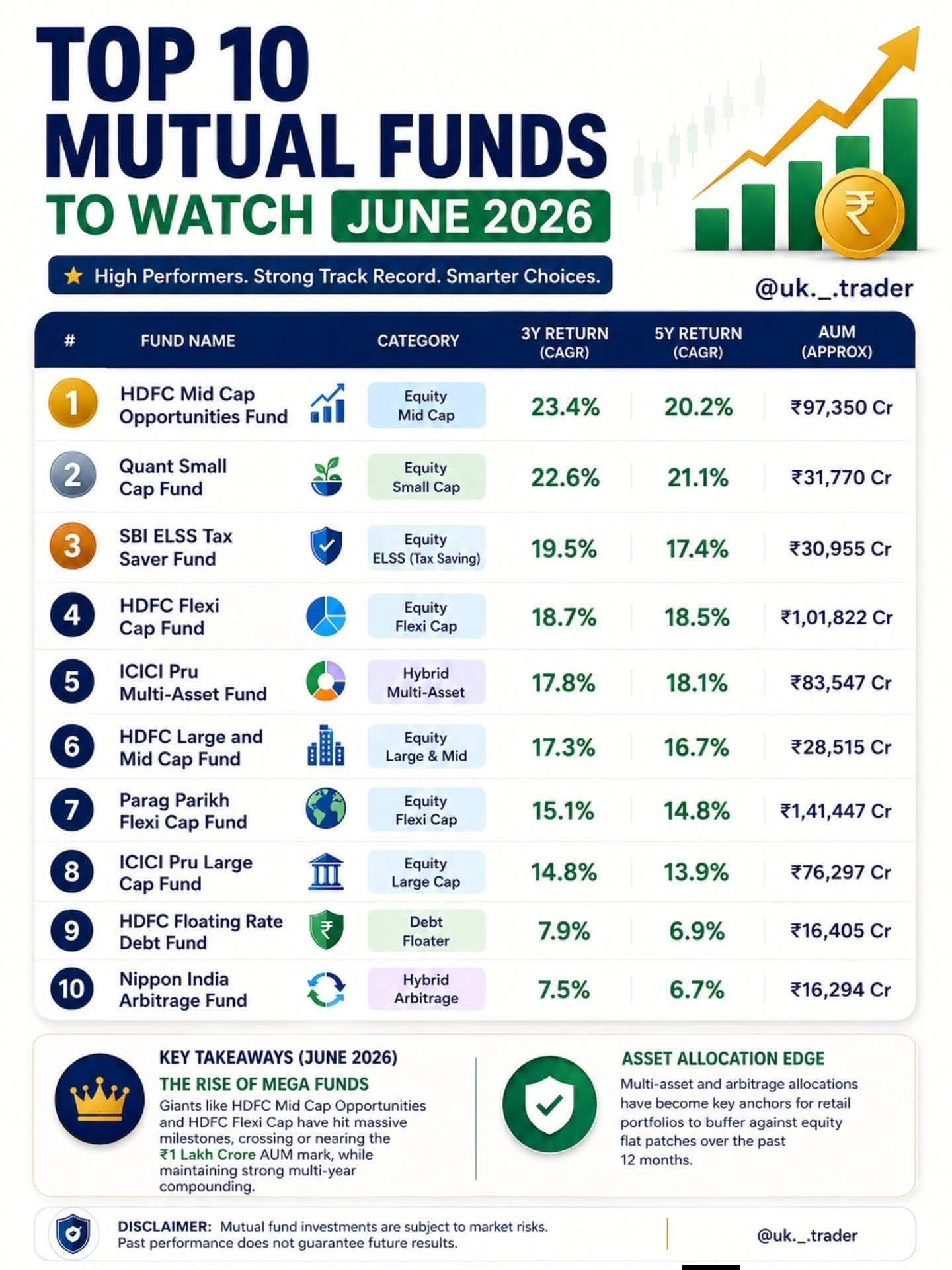
An infographic highlighting 10 mutual funds to watch in June 2026 features schemes from HDFC, Quant, SBI, ICICI Prudential, Parag Parikh and Nippon India. The list covers mid-cap, small-cap, flexi-cap, large-cap, multi-asset, debt and arbitrage categories.
Top 10 Mutual Funds Featured
1) HDFC Mid Cap Opportunities Fund – Mid-cap equity
2) Quant Small Cap Fund – Small-cap equity
3) SBI ELSS Tax Saver Fund – Equity-linked tax-saving fund
4) HDFC Flexi Cap Fund – Flexi-cap equity
5) ICICI Prudential Multi-Asset Fund – Multi-asset allocation
6) HDFC Large and Mid Cap Fund – Large- and mid-cap equity
7) Parag Parikh Flexi Cap Fund – Flexi-cap equity
8) ICICI Prudential Large Cap Fund – Large-cap equity
9) HDFC Floating Rate Debt Fund – Floating-rate debt
10) Nippon India Arbitrage Fund – Arbitrage strategy
The infographic also displays three-year and five-year annualised returns, along with approximate assets under management (AUM). These figures should be independently verified against current fund disclosures before being used for investment decisions, as performance and AUM change over time.
What Should Investors Know About These Categories?
Mid-cap and small-cap funds: These funds invest in relatively smaller companies and may offer substantial long-term growth potential. However, they can experience sharp price fluctuations and significant losses during market downturns.
Flexi-cap and large-cap funds: Flexi-cap funds can invest across companies of different market capitalisations, while large-cap funds focus on larger established businesses. Both can be useful components of an equity portfolio, depending on an investor’s risk tolerance.
ELSS tax-saving funds: Equity-linked savings schemes may qualify for tax deductions under Section 80C, subject to applicable tax rules and eligibility. They generally have a three-year lock-in period, and investors should consider whether the relevant tax regime allows the deduction.
Multi-asset funds: These funds invest across multiple asset classes, potentially including equities, debt and commodities such as gold. Diversification can help spread risk, although it does not eliminate the possibility of losses.
Floating-rate debt and arbitrage funds: These strategies differ from conventional equity funds. Floating-rate debt funds carry interest-rate and credit risks, while arbitrage funds seek to benefit from price differences between related market positions. Neither category is completely risk-free.
How to Choose the Right Mutual Fund
Before investing, consider these five factors:
Investment horizon: Equity funds are generally more suitable for longer-term goals, while shorter-term investments require careful attention to volatility and liquidity.
Risk tolerance: Small-cap and mid-cap funds can be considerably more volatile than many diversified or debt-oriented strategies.
Consistency: Review performance across different market conditions rather than selecting a fund solely because of recent high returns.
Costs and portfolio overlap: Compare expense ratios, portfolio holdings and whether multiple funds provide genuinely different exposure.
Financial goals: Choose investments based on your objectives, time horizon and ability to withstand losses.
Final Thoughts
The mutual funds featured in this list represent a broad range of investment strategies available to Indian investors. Rather than simply choosing the fund with the highest historical return, investors should evaluate risk, diversification, costs and long-term suitability.
Important: This article is for educational purposes only and is not personalised investment advice or a verified ranking of the best-performing mutual funds. Past performance does not guarantee future returns. Please verify all return and AUM figures using official fund factsheets and disclosures before investing. Mutual fund investments are subject to market risks.
Top 10 Mutual Funds to Watch in India: June 2026 Performance Guide